
Collecting
The Catskills Antique Collecting Guide
November 12, 2026 · By admin
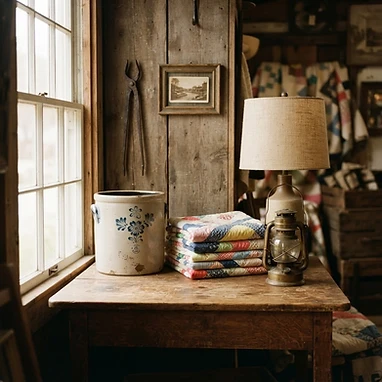
Most of what passes across our counter was never bought as an antique. It was bought new — in Wurtsboro, Liberty, Ellenville, Monticello — and then it stayed in the same family, the same farmhouse, or the same boarding house for seventy or eighty years. That is the quiet advantage of collecting in the Catskills: the region emptied out slowly rather than all at once, and it kept its things.
This guide is the one we wish someone had handed us: what the Catskills actually produced, how to read a piece in the aisle before you commit, where the honest price bands sit, and what to leave alone. It is written for the person who wants to furnish a room, start a real collection, or simply stop paying department-store prices for furniture with no story.
Why This Region Is Worth Learning
Three economies stacked up here and left three distinct layers of material behind.
The farm and boarding-house layer is the oldest. Sullivan County farmsteads, hill farms that went fallow after the 1930s, and the rooming houses that fed the canal trade all produced the same working objects — stoneware, ladder-back chairs, iron tools, quilts, blanket chests. These pieces are honest, heavy, and usually repaired rather than restored.
The Borscht Belt layer ran roughly from the 1920s into the 1970s. Hundreds of resorts, bungalow colonies and summer camps filled the county every July; when the era ended, decades of furniture, dishware, signage, staff uniforms, matchbooks and photographs came onto the market in waves. Nothing else in America looks quite like this material, and much of it is still inexpensive because buyers outside the region do not recognise it.
The canal-and-rail layer runs underneath both. The D&H Canal closed in 1898 and the O&W Railroad faded in the 1950s, but their hardware, paperwork, lanterns and stoneware are still turning up in barns and basements within a few miles of the towpath that runs behind our building.
Because all three layers overlap in one small county, a single morning here can put a stamped stoneware crock, a bungalow-colony dinette set, and a railroad lantern on the same table.
The Eight Categories Worth Learning First
You do not need to know everything. Learn three categories properly and you will out-shop a generalist every time.
1. Stoneware and crocks
Salt-glazed stoneware was the region's plastic — jugs, churns, butter crocks and water coolers, made by potters in the Hudson Valley and stamped with the maker's name and town. Look for a crisp cobalt stencil or hand-painted decoration, a clean lip, and no hairline crack running from the rim. A one-gallon crock with a good stamp is a starter piece; a five-gallon churn with a bold flower can carry a mantel all by itself.
2. Catskills camp and rustic
Paddles, pack baskets, split-oak fishing creels, Adirondack-style twig furniture, snowshoes, decoys, and enamel campware. The test here is honest wear: a paddle polished smooth by hands is worth more than one that was sanded bright last year. Repainted decoys should be priced as decoration, not as folk art.
3. Bungalow-colony mid-century
Formica-topped kitchen tables, chrome-framed dinettes, wrought-iron patio sets, souvenir glassware, hotel china, and the brightly coloured enamelware that every colony kitchen used. Condition is everything: a dinette with its original chrome and its original top is a $300 to $600 piece, while the same table repainted is a utility table. Check the chrome for pitting and the top for lifting laminate at the edges.
4. Railroad, canal and mine
O&W lanterns and timetables, switch locks, conductor's punches, coal scrip, mine lamps, hand-forged canal hardware. Railroad items are the most forged category in the country, so buy from a vendor who can tell you where the piece came from and what the markings mean. Reproductions usually announce themselves in the weight and the finish.
5. Quilts, linens and textiles
Patchwork quilts, feed-sack aprons, hotel sheets and towels, linen postcards and table runners. Hold a quilt to the light: a hundred small even stitches and a soft, worn back are good signs. Shattered brown fabrics are not a reason to pass — they are a reason to negotiate — but rot along a fold means the piece is a display object, not a bed.
6. Hand tools
Planes, chisels, drawknives, saws, braces and levels, most of them stamped by makers in New York and New England. A tool is worth buying when the blade is not pitted through and the wood is not split at the mouth. Tools are also the cheapest way to start a serious collection: you can own a genuine 19th-century object for the price of lunch.
7. Ephemera
Postcards, photographs, menus, matchbooks, resort brochures, camp registers, school diplomas and maps. This is where the Catskills story is most alive and least expensive, and it is also where the local-history collectors concentrate. Buy the images you would actually frame; a box lot of 200 postcards is research, not decoration.
8. Folk art, decoys and tramp art
Carved birds, chip-carved boxes, whirligigs, painted game boards and cigar-box tramp art. Judge it on the same terms a museum would: confident carving, original surface, no recent paint. When these turn up locally they are usually the best value in the building, because they are priced as craft rather than as art.
How to Read a Piece in Ninety Seconds
You can learn more from the back and the bottom of an object than from the front.
- Turn it over. Look at the joinery. Hand-cut dovetails that are slightly irregular mean pre-1860 case work; machine-cut dovetails are later; staples and Phillips-head screws mean the 20th century.
- Read the hardware. Cut nails point to the 19th century, wire nails to the 1890s and after, slotted screws to before 1930, Phillips to after.
- Look for the mark. Potters stamped, factories stencilled, furniture makers signed the back, quilt makers embroidered a name and a date. A maker's mark from a town you can point to on a map is worth real money.
- Read the finish. An original finish will be thin, uneven, and darker in the corners. A refinished surface is uniformly glossy and has suspiciously clean edges.
- Check the wear points. Feet, handles, drawer fronts and chair arms wear first. If those are pristine but the rest is worn, the object has been cosmetically rebuilt.
- Ask the vendor what they know. The best provenance in the building is often in someone's head rather than on a tag.
What Things Actually Cost
Price bands in this region are gentler than in the city, but they are not uniform. As a rough weather map, and always before you ask a vendor for their own number:
- Under $25 — ephemera, single tools, small ceramics, glassware, camp mugs, books, framed prints.
- $25 to $150 — the working collector's sweet spot: stamped crocks, quilts, decoys, lanterns, chairs, small case pieces, enamelware.
- $150 to $600 — chests, dry sinks, dinette sets, large stoneware, good folk art, original advertising signs, working lamps.
- $600 and up — signed or attributed furniture, rare stoneware, museum-grade textiles, and anything with documented local provenance.
Two things move a price more than anything else: original surface, and a story you can prove. Two things do not: how much the vendor paid, and how much you say you love it.
Condition: What to Leave Alone
The instinct to restore is the most expensive habit in collecting.
Leave alone: original finish and patina, original hardware, maker's marks, signatures, dated labels, and a quilt's honest wear. Cleaning off a hundred years of surface can cut an object's value in half.
Fine to fix: a loose joint reglued with reversible hide glue, a missing drawer pull replaced with a period match, a lamp rewired by a qualified person, a frame with new backing. None of these destroy the object.
Walk away from: pieces repainted over original decoration, furniture cut down to fit a wall, crocks with filled cracks sold as sound, and anything described as "restored" without a description of what was done.
Buying Well in the Building
Our market is roughly 8,000 square feet of individually run booths, which means you are buying from a hundred different small businesses rather than one store. A few habits make that work in your favour.
- Carry cash. Many vendors will do a better number for it, and every booth can take it.
- Bundle, politely. Two or three pieces from the same booth is a conversation; one piece at a lowball is not.
- Measure before you fall in love. Bring a tape and the dimensions of the wall or the back of the car.
- Ask about holds. Most vendors will hold a paid piece for a day or two if you cannot take it with you.
- Buy the provenance. A snapshot of the piece in the house it came from is worth asking for, and it is free.
Getting It Home Without Hurting It
Quilts travel in cotton or paper, never plastic, which traps moisture. Ceramics ride on a blanket on the floor of the car, not in a bag on a seat. Lamps travel with the shade off. Case goods need two people and the drawers removed. And if you are buying something you intend to insure, photograph it and keep the receipt and the vendor's name — an estate rider is easier to write with paperwork than without.
The Rest of the Region's Hunting Grounds
The market is one stop, not the only one. Estate sales and barn sales along the back roads are strongest from late spring through the first hard frost. Church rummage sales and library book-and-things sales are almost always priced to move. Country auctions still run on a summer evening with a folding chair and a number card. Thrift stores are where the ephemera surfaces first, because paper is the last thing anyone thinks is worth money.
A good weekend rhythm: estate sales in the morning, market in the afternoon, and a second pass on Sunday when a vendor would rather make a deal than pack a piece up again.
A One-Page Checklist
- Turn it over before you price it in your head.
- Look for a town stamp, a signature, or a dated label.
- Prefer original surface over a clean face.
- Check the wear points against the rest of the object.
- Hold textiles to the light.
- Weigh railroad and mining pieces in your hand.
- Ask what the vendor knows about where it came from.
- Measure the wall, the car, and the doorway.
- Pay for the piece, not for the story you are inventing.
- Buy one good thing instead of four almosts.
Start Here
You are welcome to walk the building with this guide in hand. Begin with our vendor booths and see which specialists stock the categories you care about, browse the marketplace for pieces listed online, or post what you are hunting for on the BOLO board and let a hundred dealers keep an eye out for you. Our live shows are where the unusual pieces tend to surface first, and a gift card is the safest way to send a collector you love into the building without them.
If you would rather ask a question first, write to us and we will point you at the right booth.
Further reading from the Journal: The D&H Canal: Sullivan County's Liquid Highway to History, Antique Hand Tools: Why Catskills Craftsmanship Still Cuts Deep, and Picture Postcard Wurtsboro: Collecting Sullivan County's Golden Age.